Toddler Biting
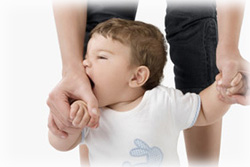
Have you received the dreaded phone call from school about your toddler's biting?
"Good morning Mrs. Johnson, this is the Happy Kids Preschool calling to let you know that Amelia was bit today..."
or worse "Amelia bit another child..."
Your first experience with toddler biting may come as a complete shock - you've always had such a sweet, well-mannered child - or it may be just another day battling your intense, spirited toddler and her many emotions.
Most parents are undoubtedly alarmed by either call.
Seeing your
child hurt or hurt another may challenge your responsibility - your ability to respond.
Biting is aggressive, scary and alarming for children and parents.
It is also completely normal.
Most children go through a biting phase and the bitten are quickly turned into biters as children learn behaviors from their relationships - not with just their parents but also with their peers.
They're emotional creatures and while biting may seem like an unforgivable reaction to a "friend not sharing" or a "toy being taken," it's also an immature reaction rather than a decision to be mean.
Yes, you must enforce the limit for safety that biting is absolutely NOT OKAY, but it's important to do that while remaining as stress-free as possible.
A fearful child cannot learn.
So, how do you stop the behavior without sacrificing your relationship with your kids?
First, understand why toddler biting happens.
As conscious
parents, we operate from the premise that all behavior is a communication about what's going on internally for a child. Behaviors are strategies to communicate how stressed they feel, how connected they are, and what skills they have to manage their behavior.
Children are learning how to interact
in social situations.
Repeat negative behavior, such as biting, is often due to a lack of maturity - not a lack of discipline.
A three-year-old does not have the cognitive resources to stop and think logically about their actions. They're all emotion and impulse.
It is only through repetitive modeling, nurturing, and having compassion for their experience that children learn to change their behavior.
Scolding children because "they were warned" or sing criticism teaches them that reactive behavior is an appropriate method for meeting our needs.
It is developmentally appropriate for a toddler to react strongly - even hostile - to an upsetting event. They are impulsively emotional
and/or physical because their brain capacity leaves them no other
choice.It is our responsibility to repeatedly model more appropriate responses.
It may be hard to see your child as afraid or lacking skills.
Traditional Parenting Response
Child B: I want my doll!! I want my doll!
Parent: It is not okay to bite your friends!
Child B: But she took my dollll!!!
Parent: I don't care, you must ask for what you want, you cannot bite people.
Child B: I want my doll, she took my doll, I want it NOW....!!
Parent: You have to learn how to ask for what you want and not use your body to hurt people.
Child B to Child A: Can I have my doll back please?
Child A: No! It's mine.
Child B: (melting down more) It's mine, it's not hers, she can't have it, I want it baaaack! (she lunges toward Child A)
Parent: That's it, I've had it. I will take the doll until everyone can learn how to share and play nicely.
This may be a fairly traditional parental response to toddler biting but how effective was this approach?
Unfortunately what the traditional parent overlooked was the message that Child B was trying to communicate. "My doll is gone and I don't know if I'll ever get it back!"
A small child does not have the ability to understand that her toy is not gone forever.
This child would benefit from reassurance that she will survive this situation and that you will always help her as best you can.
And, even when you can't help your child meet their needs, letting them know that you will be there to support them through their difficult emotions gives their brain the dose of connection it needs to strengthen its important connections.
Seeing things from your child's perspective is crucial to understanding their actions.
You can diminish unwanted negative behaviors by acknowledging the need, lack of skill or fear that caused the behavior in the first place.
Traditional parenting asks us to focus on the behavior and suggests that if you get emotional with your kids, you are coddling them.
This could not be further from the truth.
Fear-based reactions only escalate things. In the above scenario, neither child was motivated to change and when they did not "behave" as expected - the toy was taken away.
How does everyone feel after this kind of discipline?
Child A? Child B? The Adult?
The traditional parent also could have used further negotiation, demands or emotional manipulation such as:
Guilt: "Why would you bite your friend like that? Don't you want to share with your friends?" or "If you bite your friends, no one will want to play with you."
Judgment: "That is a terrible thing to do to your friend. I taught you better than that!"
Fear/Force: "You apologize to your friend right now or I will take the doll away!"
Conditions: "When you can act appropriately, you will get your toy back."
None of these approaches acknowledges the feelings or needs of the child and only impose more fear and stress by demanding compliance through control or shame.
This parenting style distances us from our children and harms our long-term relationship.
After discipline, always ask yourself: Has the relationship with my child been improved through this interaction? And if the answer is no, then investigate how can you can reconnect to build trust.
So what CAN you do to stop toddler biting? Click here to continue reading...
I love hearing from you, so leave me a comment below. Share your stories, let me know what conscious parenting tips work for you or post your challenges and find support.